Records of a bridge over the Maritsa River in Plovdiv date back to the 15th century. In a map of Plovdiv and the surrounding area, which was drawn in 1827 by the French reserve officer A. Jagerschmidt, as well as in a district map of Plovdiv created by Guillaume Lejean in 1867, a bridge is marked approximately where the old bridge once stood.

Its beginning was at Malkata Glavna (Little Main Street), also known as “Raiko Daskalov” Street and it ended at “Karlovska” Street. During the Russo-Turkish War, in early 1878 the retreating Turkish forces burned the bridge in order to halt the Russian forces which advanced towards Plovdiv. A year later, on April 23 1879, it was rebuilt by Vasily Yurgovets’ craftsmen. Even the acting governor of Eastern Rumelia, Arkady Stolypin, attended the official opening ceremony. In his honor, the bridge was named the “Stolypin Bridge”.
During the aftershock of the Chirpan earthquake, when one-third of the buildings and structures in Plovdiv were destroyed, the old Maritsa bridge remained intact. Later, copper cables for Plovdiv’s first trolleybus line went over the bridge. However, early on the morning of March 30th 1971, due to rising river waters, the bridge collapsed.

Photos: Бай Иван Карачомака
Construction of the new bridge began on January 9th 1982, east of the collapsed in 1971 bridge. It connected “Raiko Daskalov” Street on the south bank and “Brezovska” Street on the north bank near the Grand Hotel Plovdiv. The bridge was opened in 1986 and officially named “Saedinenie” though few people know it today by this name. It was the first structure in Bulgaria to be built using the cantilever method. The bridge is 16 meters wide, constructed by the company “Moststroy”, and required the Maritsa River to be temporarily diverted with dams for the installation of its elements. After completion, the bridge was tested to withstand the weight of 50 tanks parked on it.

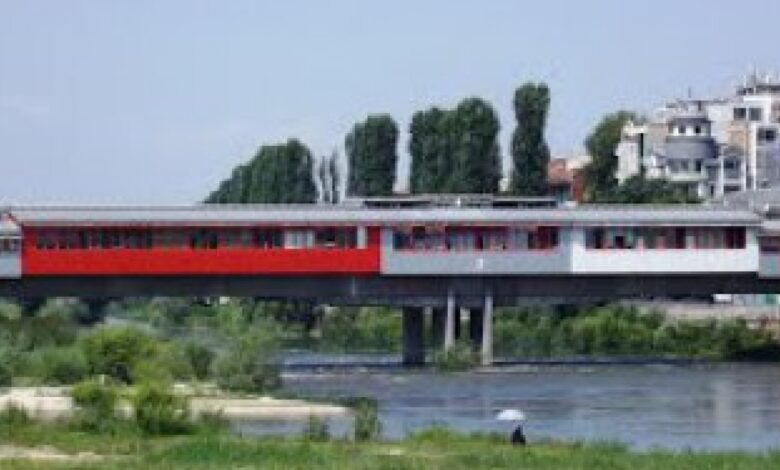
The bridge was mainly intended for pedestrian use, with vehicle access allowed only in emergencies. It was later covered with light metal structures during the time of Mayor Dr. Ivan Chomakov, transforming it into a commercial zone. The redesign was completed by Marcho Minev and Dimitar Kumanov. Due to the red-and-white colors of the metal structure’s exterior and the window arrangement, residents of the city began to call it “The Train”.

Photos: Tranh Tran за Акция „Фото Пловдив“
Recently, in a Facebook group with vintage photos, pictures and memories of a walk across the bridge in 1991 resurfaced. This takes us back to the time when the bridge offered a much more pleasant and green panoramic view.
Do you remember it like that?