The Italian presence in Plovdiv dates back to the 1840s when Andrea Canova became the vicar of the Catholics in the region. Contemporaries described him as an intelligent and energetic man. He was accompanied by two young clergymen, Father Eduardo from Turin and Father Samuel from Prato, who assisted him in both the spiritual and economic development of the local Catholics. Thanks to their efforts, a school was opened in Belozem in 1845. Father Eduardo even authored a Bulgarian history book written in Latin script but in the spoken Bulgarian language. One of the copyists of this so-called Pavlikian history was the grandfather of the famous painter Tsanko Lavrenov.

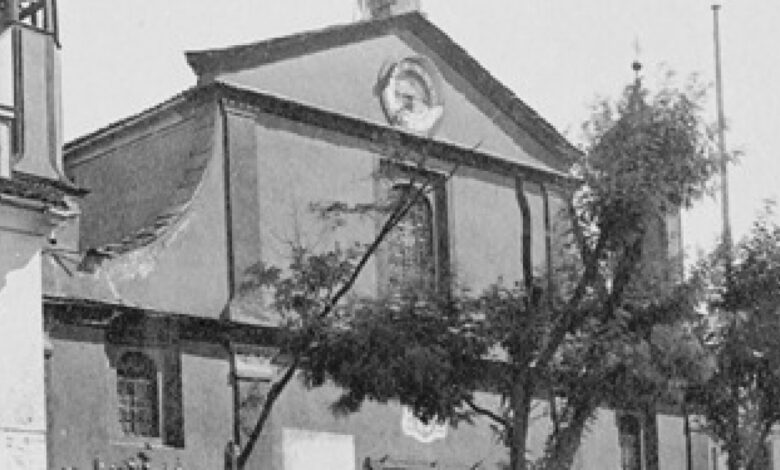
From 1850, already a bishop of the Southern Diocese, Andrea Canova began establishing a separate Catholic district in Plovdiv. The central place in it was occupied by the church of St. Louis, whose construction began in 1851 and was consecrated about ten years later. Next to it was the bishop’s residence. Canova purchased land around the cathedral and gave it to Catholics to build their homes. He also built the St. Andrew School and brought a clock for the church of St. Louis, installed in 1866. His efforts helped bring European consuls to Plovdiv, and in recognition of his contributions, France awarded him the Legion of Honor.
One of Canova’s followers, Francesco Domenico Reinaudi, founded a choir at St. Louis Church in 1851. About a decade later, Plovdiv already had an orchestra and a mixed choir. During this period, Luigi Fortunato, a piano teacher, also worked in the city. The Italian musical presence remained influential in Plovdiv’s cultural life until the 1920s.
In 1868, Damazo (Domenico) Takela, a grain merchant, settled in Plovdiv. Born in Genoa or Ajaccio (Corsica) in 1832, his main warehouses were in Plovdiv and Constantinople. In 1873, he opened an office near the railway station in Kayadjik (now part of Dimitrovgrad). After the April Uprising, he donated large sums to aid the victims in Batak, Perushtitsa, and other towns. He also organized the transportation of orphans, who were left without nothing after the destruction. During the Russo-Turkish War (1877-1878), Takela supported 4000 Stara Zagora residents who had survived the destruction of their city.
Takela was also one of the founders of the Plovdiv National Library and Museum, forming a significant collection of ancient coins. From 1882 to 1903, he headed the numismatic department of the National Museum in Sofia, leaving behind meticulous documentation of each coin.
His son, Atilio Takela, had a less favorable reputation. As the head of the numismatic collection at the Plovdiv National Library, an inspection in 1901 revealed missing inventory numbers, lost pages from the records, and the disappearance of valuable coins. This led to two trials, a harsh sentence, and eventually a controversial amnesty granted by Prince Ferdinand.
The construction of the Belovo-Constantinople railway in the 1870s led to the arrival of new Italian settlers. Around this time, Antonio Arena opened the first local pasta factory, producing macaroni, noodles, and Italian specialties. Italian traders followed, increasing their presence in the city’s economy.
One of the most influential Italians in the economic development of Plovdiv was Carlo Alberti Vaccaro. He arrived from Constantinople and took on the ambitious task of importing agricultural machinery from Europe and America, despite initial skepticism. By 1892, newspapers were calling him the “teacher of the Bulgarian farmer”. Another significant contribution was the Plovdiv branch of the Ottoman Bank, where an Italian team played a key role, although their efforts remained largely unnoticed by the press.

Italian influence in architecture was also profound. In the mid-19th century, the Catholic church of St. Louis in Plovdiv was designed by Alfonso from Rome and built by Ivan Boyanov from Bratsigovo. From 1879, Pietro Montani, an architect in the service of the Ottoman Sultan, became the chief regional engineer of Eastern Rumelia, marking the beginning of a 40-year period of Italian architectural presence in the city.
Among the notable Italian architects in Plovdiv were Mariano Pernigoni, Ferdinando Torensoni, and Visetti, the inspector of the Eastern Railways. In 1891, Visetti designed a new Catholic church in Sekirovo (now a district of Rakovski). In 1892, he planned Plovdiv’s first tramway, though the project was ultimately abandoned due to financial constraints.
One of the most significant Italian artists in Plovdiv was Quinto, who arrived in 1880. He painted the ceiling fresco of the “Luxembourg” theater and designed the sets for Bulgaria’s first professional drama troupe. Though he didn’t reside in Plovdiv, sculptor Arnaldo Zocchi left a lasting mark. Bologna has the Garibaldi monument, Buenos Aires – the Columbus Monument, Cairo has the monument of St. Francis of Assisi, The US – the statue of Lafayette, while Plovdiv has the fountain in Tsar Simeon Garden (though only ruins remain today). Professor Gentini was another Italian artist who contributed by crafting the sarcophagus of Bulgarian Princess Maria-Louisa.
The 1880s and 1890s were the most productive years for the Italian colony in Plovdiv. Though smaller than the German and French communities (which exceeded 100 people), the Italian presence constantly attracted media attention. In 1883, when Deniso Takela became Italian consul, the colony established the Giuseppe Garibaldi Charity Society and an Italian school. In 1891, the school became open to Bulgarian and other non-Italian children in Plovdiv.
Until the early 20th century, Italians actively participated in civic life—establishing the Citizens’ Club, organizing charity concerts, and celebrating the Italian National Day with dances and live music. The attendees danced traditional Italian dances such as tarantela and traditional Bulgarian folk dances, the musicians played up until and after midnight. However, the wars of the 20th century led to the decline of these activities. A new revival began in 1926 with the reopening of the Italian School, named “Vittorio Alfieri”, which later became the Italian Royal Mixed Gymnasium. Meanwhile, the Giuseppe Garibaldi Charity Society changed its name to the Fascist Society. By the late 1930s, two Italian radio stations broadcast in Bulgarian, greeting listeners from Plovdiv.
In December 1930, Plovdiv hosted the world’s largest marionette theater, Teatro dei Piccoli, sparking great enthusiasm. This led to the creation of the Italo-Bulgarian Society, which brought renowned Italian writers, musicians, and public figures to the city. Among them was Maria Luisa Fiumi, a famous Italian writer.

Plovdiv also gave rise to a European music star. In 1926, an unknown singer named Enrico di Mazzei debuted at Opéra Comique in Paris. Within a year, he was being compared to Enrico Caruso and Beniamino Gigli. Behind this stage name was Enrico Takela, son of Atilio Takela. Born in Plovdiv in 1894, he grew up in the Takela family home, located where today’s Ivan Vazov National Library stands. Enrico studied in the French College “St. Augustin”- Plovdiv, later he continued his education in Italy, and graduated from the Geneva Conservatory of Music.
From the 1880s to 1944, the Italian colony in Plovdiv fluctuated between 50 and 250 people, including teachers, priests, traders, artists, and craftsmen. The peak was in 1942, with almost twice as many registered Italian citizens in police records.