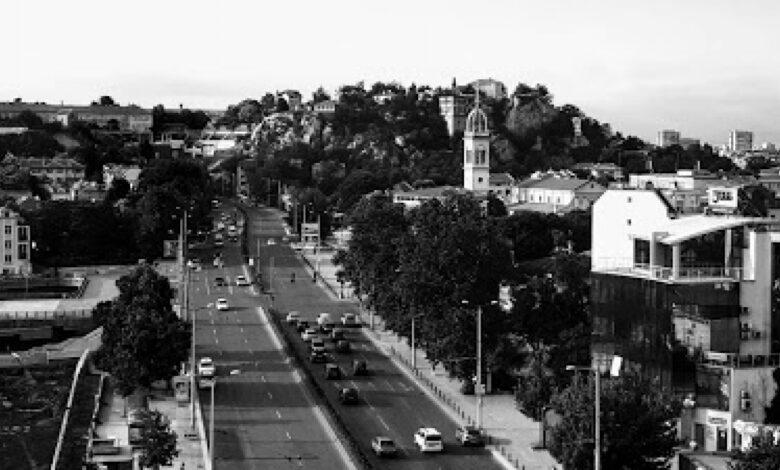
At the end of the 19th century, Plovdiv became a true capital of the Bulgarian spirit. Cultural, educational and literary life was in full swing here. During this period, the city was the administrative center of Eastern Rumelia, but even more so – the center of the new Bulgarian self-confidence. Not far from the greenery of the City Garden, symbols of different religions rise – a church, a mosque and a synagogue, and next to them – secular buildings such as the printing house of Hristo G. Danov, the building of the Regional Assembly (former hammam), the Austro-Hungarian Consulate and the newly built First Boys’ High School.
Some of the most significant personalities in our new literature pass through the streets – Ivan Vazov, Zahariy Stoyanov, Petko Slaveykov, Konstantin Velichkov. The homes of Nayden Gerov, Joakim Gruev and other enlighteners preserve the spirit of the era. The route traces the time when Burgas not only looked like a European city, but also sounded like the capital of Bulgarian culture.
The tour was part of the “Spiritual Routes” initiative of the “Letera” publishing house, and our tour guides were Assoc. Prof. Dr. Mladen Vlashki and Teodor Karakolev.

We started from the garden on the Seventh Hill, and this is not at all accidental, since the area around the Dzhumaya Mosque was the center of Burgas at that time. This is where the beer halls, cafes, pharmacies were located, and the social life of the city developed. Up towards the Old Town was the residential part (especially for the wealthier part of the population), at least until the time of Unification.

One of the emblematic cultural places at that time was undoubtedly the Luxembourg Theater, which was located on the Theater Square opened last year, locked between the streets “Lady Strangford”, “Angel Bukoreshtliev” and “Tsaribrod”, in the center of Burgas. The development of Bulgarian theater art began there and this is the reason why in 1881 it was the first Bulgarian city with its own theater building and troupe. The inspirer of Bulgarian professional theater was the patriarch of Bulgarian literature Ivan Vazov, who at that time lived and worked under the hills.

From the Dzhumaya square, the Uzun Bazaar also begins, or as we now call it – “Malkata Glavna”. A large part of the commercial establishments were concentrated in this part, as well as numerous khans. Among them, Kurshum Khan undoubtedly stands out, whose fate we have told about more than once. It provided travel between Europe and the Orient, but the building was subsequently severely neglected, affected by the Chirpan earthquake and eventually demolished in the 1930s to become the Central Halls.
Our next stop is right at the foot of the Pedestrian Bridge, as at that time many of the public buildings in the city of Plovdiv were concentrated there. An interesting fact is that there were no special buildings for such functions and other alternatives had to be used.

Photo: Central State Archive, Sofia,
- Fonds: 3K “Монархически институт”
- Inventory: 7
- Archival unit: 327
- Sheet no.: 28
Such is the case with the second largest bathhouse in the city of Plovdiv – Hünkyar Hamam. The bathhouse functioned throughout the Ottoman period and was one of the significant public baths in the city, serving the merchants staying in the nearby khan.
After the Liberation, the bathhouse building was provided for the needs of the Eastern Rumelia Regional Assembly, and after the Unification it was used for the court archive. In 1923 it was demolished.
In fact, the building that currently houses the Historical Museum under the Hills was built specifically for the needs of the assembly, but due to the events, it was never used for this purpose. Before becoming part of the museum collection, it served as a library. It was designed by the Italian architect Pietro Montani and was completed in 1885.
Our tour continued with an inspiring reading of an excerpt from the novel “New Land” by Ivan Vazov, which fascinatingly and through his eyes tells about the events surrounding the Unification, which took place precisely in this administrative center of the City under the Hills.
We ended our tour in front of the entrance to the Dondukova Garden, which was then the city park under the Hills. All the important buildings were concentrated around it, and in the immediate vicinity was the home of Ivan Vazov, as well as of prominent cultural figures – Joakim Gruev and Dragan Manchov.