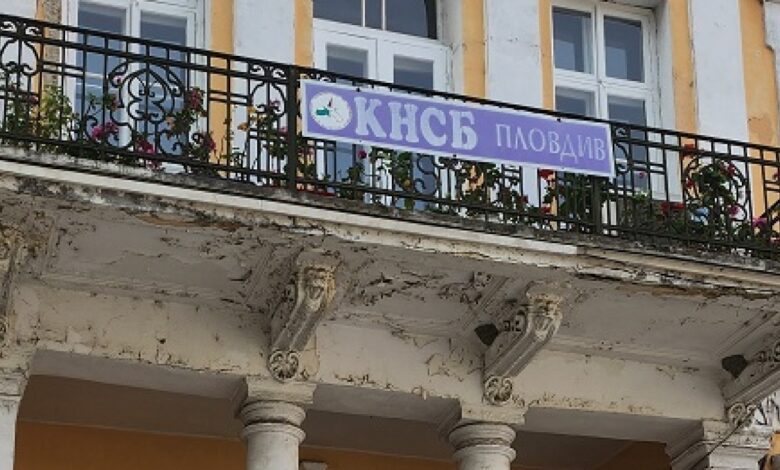
Built in 1907 in a classical style, the house was originally a two-story residential building with much smaller dimensions than today. Although we now perceive it as a single unit, over the years it has undergone changes, extensions and adaptations. In 1921, an extension was added to it and the two parts existed as separate buildings for a long time, united only later.
The most interesting is the small part on the right, if we stand against the facade. At the beginning of the 20th century, it had large storefront windows, a lower floor and direct access from the street – characteristic features of a commercial space. Historical information indicates that this is where a pharmacy was housed. Currently, there is no trace of the storefronts – between the 1970s and 1980s, they were remodeled to resemble the windows on the upper floors, and the original appearance is gradually fading.
In 1921, the building on Hristo G. Danov Street began to serve as the city administration. This coincided with the second term of Dr. Ivan Kesyakov as mayor of Plovdiv – from March 1, 1921 to September 28, 1922. A figure with an important place in the city’s governance, Kesyakov had already been mayor once before, in the period 1908–1912, and it was during his second term that this building went down in history as the first city hall of Plovdiv.
Located in one of the oldest and most culturally rich streets in the city, the building naturally fits into the atmosphere of the area. “Hristo G. Danov” is a kind of archive of post-liberation Plovdiv, and today it is mainly a commercial artery with a variety of shops for clothes, accessories, musical instruments, etc.
The building is a cultural monument and property of the Plovdiv Municipality, but its condition clearly shows the signs of time. The facade is worn out, the decorative elements have lost some of their shine, and traces of various interventions over the decades are visible. The good news is that a restoration project has already been won, which envisages the restoration and conservation of the facade. If it is implemented, the building will have a chance to tell its story again – this time not only to curious passers-by, but also to future generations.