We start our tour from the most artistic area under the hills – Kapana, which is known not only for its art shops and workshops, but also for the numerous establishments where you can eat and have fun from dawn to dusk.
Support yourself well with a cup of aromatic coffee or hot tea, choose something nutritious for breakfast and then prepare to immerse yourself in all the most remarkable places in Plovdiv.

With its 1750 meters, the main street in the city is the longest pedestrian zone in Europe and a walk along it is absolutely mandatory. If you start from Kapana towards the Central Square, you will first find yourself among the remains of the Ancient Roman Stadium. Its length is 240m, with its northern end still on display, while the rest is located under the main street of Plovdiv. In the past, gladiatorial battles, sports competitions and the famous Alexandrian, Kendresian and Pythian Games were held here.
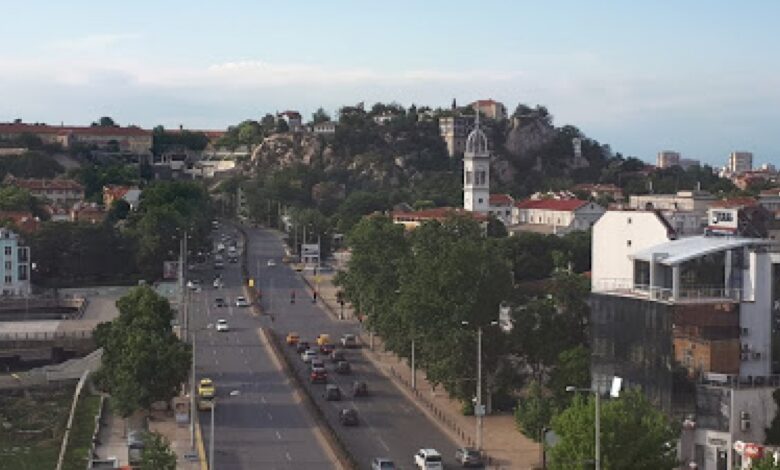
We continue down to the famous stairs to Sahat Tepe, on the top of which is the only water clock of its kind in Bulgaria. From there, a magnificent panorama of the city opens, and the approach to the hill itself can be compared to the Spanish Steps in Rome.

We move a few more steps straight and find ourselves on the square in front of the Municipality in Plovdiv, and there we will reveal to you the most fun and recently discovered place under the hills. The space combines the work of over 30 contemporary artists who worked on the overall vision and individual “exhibits”. Fantasy-NOT-The Museum has no claim to be a museum institution, but it tells the history of Plovdiv so sweetly that you can taste its taste and aroma, hear its sounds, feel its rhythm.

And if someone tells you that here every corner in the center is a history, this will not be an exaggeration at all. A true open-air museum is the area around the Central Post Office in Plovdiv, where the administrative heart of the city used to be. The Forum Complex of Philippopolis is the most magnificent part. A series of important public buildings were located there, as well as numerous commercial establishments.

Right above it rises the building of the Episcopal Basilica, the largest and most ornate temple in the Balkans. It is believed that the basilica was built after 313, when Christianity was legalized in the Roman Empire. The church was the heart of Christian life in the city between the 4th and 6th centuries before being destroyed and abandoned, perhaps as a result of a strong earthquake. Subsequently, the site was studied, restored and exhibited, and the mosaics with which the floor was covered are some of the most interesting finds. They occupy an area of nearly 2000 sq. m and have interesting motifs. They are filled with different colors and shapes, and in many places there are images of birds.
We return to the magical atmosphere of Old Plovdiv, but this time we turn from the Main Street to that of the parallel culture – Otets Paisii. There were dozens of shops there at one time, and today it is known as the Goldsmiths’ Street, as the jewelry trade is concentrated on it. In addition to the shops, you can find craft and fashion studios, many cultural havens and, as everywhere in Plovdiv – the most ancient history.

The first stop in Old Plovdiv cannot be other than the Ancient Theater of Philippopolis. It is among the best preserved ancient theaters in the world. With its 28 concentric rows of seats, interesting inscriptions and wonderful statues, it attracts every eye and carries the spirit of Ancient Rome. The viewing areas there are oriented to the south, revealing an impressive view of the ancient city in the lowlands and the Rhodope Mountains. Thanks to its specific architecture, the acoustics are unique.
Here, every street is a frame, and in addition to the exhibitions of the Historical and Ethnographic Museums, do not miss visiting the other Renaissance houses, which with their impressive collections tell of bygone times of greatness.
End your walk at sunset on the top of Nebet Tepe, revealing one of the most unique panoramas of the City of Hills. The existence of the ancient city began from there. The first stone in the development of the settlement was laid there 8 thousand years ago. On Nebet Tepe, data were found about the oldest settlements on the territory of today’s city, dated to the 6th millennium BC. Epochs and civilizations have been layered on top of each other in this part of the Three Hills, declared a cultural monument of national importance and undoubtedly one of the most important cultural and historical sites not only in Bulgaria, but also in the Balkans.
And then – the destination is Kapana again, from which there is literally no way out! For a delicious dinner and then a drink at one of the best bars under the hills.