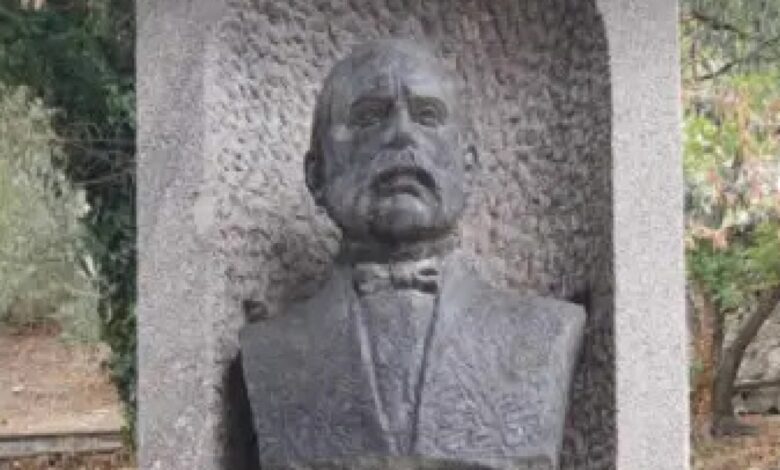
Born in 1828 in Koprivshtitsa, Yoakim Gruev grew up in an enlightened and prosperous family where books and knowledge were held in the highest regard. From an early age, he was raised in a spirit of patriotism, and after completing his education, he chose to devote his life to the teaching profession. For nearly three decades, he taught in Koprivshtitsa and later at the Plovdiv Class School, which at the time was considered the most prestigious educational institution in the country. Among his students were some of the most prominent figures in Bulgarian history, including Vasil Levski, Ivan Vazov, Todor Kableshkov, Konstantin Stoilov, and Ivan Evstratiev Geshov.
Yoakim Gruev remains in history as a true innovator in the field of Bulgarian education. His work extended far beyond the classroom and was focused on the comprehensive development of a modern educational system.

As an author and translator, he wrote and translated dozens of textbooks in grammar, history, geography, and mathematics, laying the foundations of modern Bulgarian education. His work “Foundations of Bulgarian Grammar” became a desk reference for generations of teachers.
Equally significant was his publishing activity. He edited and published newspapers and magazines such as Letostruy, Nauka, and the newspaper Maritsa, which he transformed into a powerful public platform for defending Bulgarian national interests.
In his capacity as Director of Public Education in Eastern Rumelia, Yoakim Gruev played a key role in the establishment of the Ivan Vazov National Library in Plovdiv, as well as the first Bulgarian museum. For him, these institutions were essential to the dissemination of knowledge and the preservation of the nation’s cultural memory.
Together with Nayden Gerov, he was among the initiators of the celebration of May 24 – the Day of Saints Cyril and Methodius, which, at his proposal, became a nationwide holiday dedicated to Bulgarian education and culture.
Yoakim Gruev also took an active part in the church-national struggle. During the April Uprising, he was arrested and spent 50 days in prison, despite not participating directly in the events. Among the most absurd accusations against him was the claim that he had “invented” the name Plovdiv in order to emphasize the city’s Bulgarian character and inspire confidence among the population. After the Liberation, he continued to serve his homeland, holding responsible positions in the state administration.
Yoakim Gruev passed away in 1912 in Plovdiv and was buried in the courtyard of the Church of the Holy Mother of God.

In our article dedicated to the deeds and homes of the National Revival figures beneath the hills of Plovdiv, we also present the recently renovated house of Yoakim Gruev, located at the foot of Sahat Tepe. Today, the building houses the “Maychina Grizha” kindergarten. Designed by architect Yosif Shniter, it stands out with its elegant architecture—featuring a refined colonnade, a spiral staircase, and a spacious terrace.
Plovdiv is now also home to a square named after Yoakim Gruev. Located near his monument, close to the Monday Market, the square was officially named by a decision of the Municipal Council on November 21, 2024, following a proposal by Plovdiv citizens.