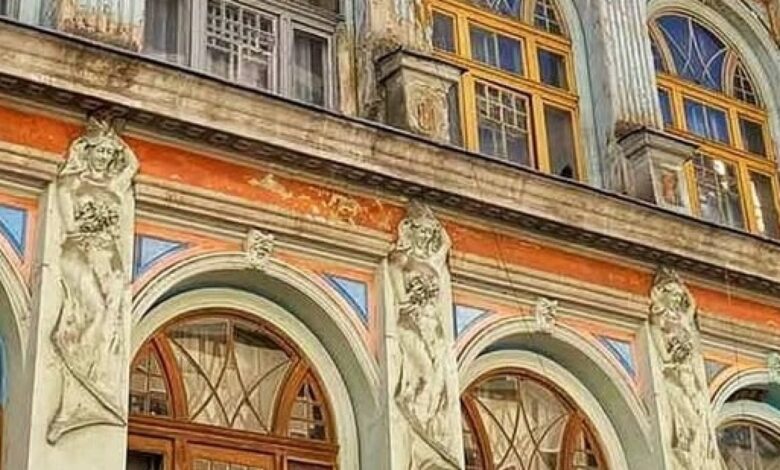
This magnificent building is located at “Hristo G. Danov” Street, 17 and was created with love and inspiration by the Italian Emilia Favretto-Sabeva, who was not only an architect but also an artist. Her husband Dr. Atanas Sabev acquired the property, and she designed the house in a style reminiscent of Venetian elegance.
Emilia herself was from Venice and, upon arriving in Bulgaria, applied for Bulgarian citizenship. She was a relative of the famous Italian painter Giacomo Favretto. She studied at the Royal Academy of Florence under the renowned Professor Razi, specializing in artistic criticism. It is likely that she met the talented Bulgarian painter Georgi Mitov in Florence. A lasting memory of this acquaintance is a beautiful portrait painted by Mitov in 1897.
Three years later, she settled in Plovdiv with her sons, not just to secure a livelihood but to contribute to both themselves and Bulgaria.
Emilia Favretto-Sabeva was one of the first female architects in the country. She also created the sculptural figures that once adorned the famous “Maritsa” pharmacy building and the decorative elements of the “Metropol” hotel (now part of the facade of the Plovdiv Theatre on the main street).
It is known that she had a deep appreciation for opera. Her dream was to establish an opera house in the city, but sadly, this dream of hers never came true. Her son Sabcho Sabev became one of Plovdiv’s greatest opera singers. Together with his mother were among the founders of the House of Arts and Printing in the city.
The construction of the impressive house began around 1910-1911 and continued until approximately 1920.
The overall facade composition facing the street is truly unique—there is no other like it in Plovdiv. The first floor is divided by pilasters decorated with exquisite bas-reliefs of female figures holding flowers, which give the building its romantic name – “The House with the Nymphs”.
However, the truth is that the seven female figures were incorrectly called nymphs; they are actually Caryatids (from Karyai, a great city-state that participated in the burning of Athens and lost the battle). The women of Karyai, immortalized in art and legend, were punished to bear the weight of shame, supporting the burden with their hands.
The windows and balconies are also interesting, as they do not follow a strict geometric order but form elegant curves. These details reflect the refined taste and artistic talent of Emilia Favretto-Sabeva.
The house is entered through a characteristic passageway of its time. The ceiling features ornaments, some of which have retained their authentic color. Beautiful curved staircases with wrought-iron railings on both sides of the passage lead to the residential area.
Despite undergoing many renovations over the years, the building has retained its unique beauty and charm. An interesting fact is that one of the basement rooms houses a well which adds another distinctive feature to the house.
Dr. Atanas Sabev, the architect’s husband, established the first private commercial school in the building—”Evlogii Georgiev” also known as the “small commercial high school”.
Unfortunately, today the house is in a bad condition and suffered a fire in 2017. Even so, it continues to exude the aristocratic spirit of the past and serves as a reminder of a time when Plovdiv was home to distinguished personalities and cultural figures.