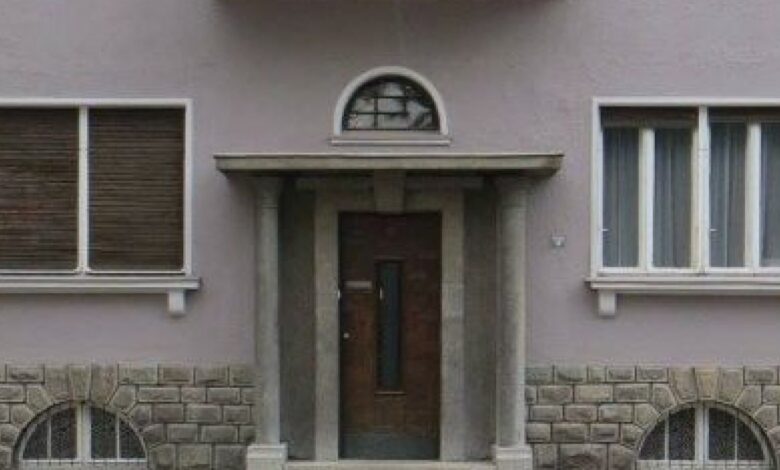
The Button Square—or, as we previously revealed, the place where the circus tent used to be erected many years ago—is one of the liveliest spots in Plovdiv but is rarely referred to by its official name, “Stefan Stambolov” Square. We have dedicated a separate article to its history, but today we will tell you about one of the most beautiful buildings in the area, which is often overlooked because of its clean and simple architecture. Its elegance is understated, and it does not immediately capture attention unless one appreciates its refined minimalism.
This house, one of the few built on the square in the 1930s, belonged to the Protochristov family—Kleo and Stefan. It was constructed in 1937, designed by the renowned architect Stoyko Stoykov.

The story begins ten years before the house was built when the Samooglu family, who owned the property, found themselves in dire financial straits. This Greek family from Asenovgrad was struggling financially, burdened by unpaid debts which many people owed to them. With no means to recover, the brothers had no choice but to call their sister, Kleoniki Samooglu, who was studying music in Vienna, back to Plovdiv.
Despite her passion for the arts, Kleo took charge of the situation. She sought the help of a lawyer to collect the family’s outstanding debts. After consulting various attorneys, she found Stefan Protochristov, who would later become her husband.
At the time, nearly the entire neighborhood between “Lavelle” Street and “Naiden Gerov” Street was owned by the Samooglu family. The first building constructed in the area was a hotel, Hotel Palace, at the corner of “Lavelle” and “Naiden Gerov”. The last building to be erected on “Stefan Stambolov” Square was the Protochristov family home—Kleo and Stefan’s house. Unlike most of architect Stoykov’s works, which typically featured Art Nouveau and Art Deco styles—tall, narrow windows and decorative yet minimalist facades—this house stood apart. Its facade lacked ornaments, the windows were short and wide, and its grand entrance was defined by two columns.

World events soon intertwined with the family’s fate. In 1941 Bulgaria entered World War II, and for a brief period, German officers were stationed in the house. After their departure, the house remained vacant for a short time before becoming the headquarters of the Red Army following the events of September 9 in 1944.
Even after the Soviet troops left, the house suffered further hardship. From the 1940s to the 1970s, Bulgaria’s housing crisis law allowed the government to place random tenants in wealthier homes. This meant the small two-story house suddenly became a shared residence for multiple families, each occupying a single room. The communal kitchen was shared by all, and little regard was given to the preservation of the house’s history or architecture.
This negligent attitude toward the building ended around the 1960s when the house owners were fortunate to have “tenants” assigned by the central authorities. For a time, two opera singers lived there. In the early 1970s, the renowned conductor Mesri Mehmedov also resided in the house for a short period while staying in Plovdiv.
By the time of Mehmedov’s passing, the housing crisis law had been repealed, allowing the Protochristov family to regain full use of their home. Though the house suffered damage from previous tenants who had little respect for its heritage, its interior retained much of its original beauty—intricate mosaics, plaster ornaments, and distinctive lighting fixtures. Over the decades, the surrounding cityscape changed drastically. The Pampulov family once had a house where today’s children’s playground stands. The Protochristov house originally had a courtyard stretching to the backstreet “Naiden Gerov”, but this was seized by the government to make way for a residential block and small parking lot. The house narrowly escaped demolition during the socialist era when the municipality planned to extend “Gurko” Street right through it. Additionally, the city authorities often inspected the house, considering its expropriation for administrative use. However, its small size ultimately spared it.

Despite everything, architect Stoykov’s creation stands to this day. Thanks to the dedication of the descendants of the family, the house remains one of the best-preserved and well-maintained modernist buildings in Bulgaria.