For centuries, Plovdiv has been known as a multicultural city, where to this day people of different religions and ethnicities live together, forming their own neighborhoods and quarters.
There is evidence that the Armenian community began settling in our city around the 5th century, when a large group arrived from Byzantium. Another major wave came to Bulgaria due to the genocide in 1922, when Armenians crossed through Turkey, mostly from Çorlu and Malkara. Many of them settled in the areas of the Kapana district and the Three Hills (Trichalmie).
Currently, official data shows about 5500 Armenians living in Bulgaria, although the exact number in Plovdiv is unknown. Still, today perhaps the most active and vibrant Armenian community in the country is the one in Plovdiv.

Our guides through the history and architecture of the Armenian Quarter under the hills were Adelina Kalapchieva from Association 365 and Teodor Karakolev, part of the “Bulgarian Architectural Modernism” foundation. They began their tour at Marukyan Square, better known as the Wide Area in Kapana, where the famous Marukyan family hardware store is located. The family is known to have relocated from Edirne in 1925 and opened their business here. Over the years, the store was nationalized, but in the 1990s it was returned to the heirs and functioned as intended until recently.

However, due to the overall transformation of the area, they decided to adapt and opened the cocktail bar “Zhelezariya” (The Hardware Store), which still preserves the spirit of the original business in its interior.
The building itself was designed by the famous Plovdiv architect Hristo Peev in a modernist style and was completed in 1940. It was built in two parts on two separate plots. Today, it is well-maintained and preserved in its original style. A typical canopy and semicircular volume stand out clearly. Another thing which is specific to the period is the layout: a commercial or workshop space on the ground floor and residential areas, usually occupied by the family, on the upper floors.

After another stop in Kapana at the home of Sarkis Hovsepian—also designed by architect Peev—we headed to “Krikor Azaryan” Street in Old Plovdiv. He was a famous Bulgarian theater director of Armenian descent, born in Plovdiv. He staged many productions—from Bulgarian authors to works by Shakespeare. Some of his most well-known students at NATFA include Marius Kurkinski, Petar (Chocho) Popyordanov, Koina Ruseva, and others. He also worked closely with the great Todor Kolev. His birth house has since been demolished, but a relief of him with a famous quote can still be seen on one of the buildings.

Nearby is the house where the first communist newspapers for Armenian news were published between 1920 and 1923. Unfortunately, today we can only judge its historical function by a commemorative plaque, as the building itself is in very poor condition.

The guides and their engaging stories also took us to the Hindliyan House, one of the most impressive stops on the tour. It belonged to the wealthy merchant Stepan Manuk and was built between 1835 and 1840. The painting of the house took six months, and today it is excellently restored. The owner was known as Stepan Hindliyan, also called Hindioglu by Turkish settlers because many of his trade journeys led him to India.

The house featured the only private bath of its time, built from marble and gypsum. It also introduced the first underfloor heating. It is further known for its beautiful indoor fountain on the spacious second-floor hall (hayat), from which rose water constantly circulated.
When the Turkish persecutions of Armenians began in 1915, Hindliyan and his family left the house and gave it over to Armenian refugees. Until 1974, when the house was declared a cultural monument of national significance and restoration began, 23 Armenian families—61 people in total—lived there.

We continued our walk past the houses of Krikor and Stepan Mesrobovich. One of them is currently an unfinished reconstruction of one of the most interesting Revival-era houses, demolished during socialism. Fortunately, in recent years, an investor bought the plot, and archaeological excavations are underway. A hotel-gallery is expected to be built there eventually.
In Krikor’s building, there is an exhibition of Tsanko Lavrenov, and until recently it also housed an exhibit dedicated to Mexican art.

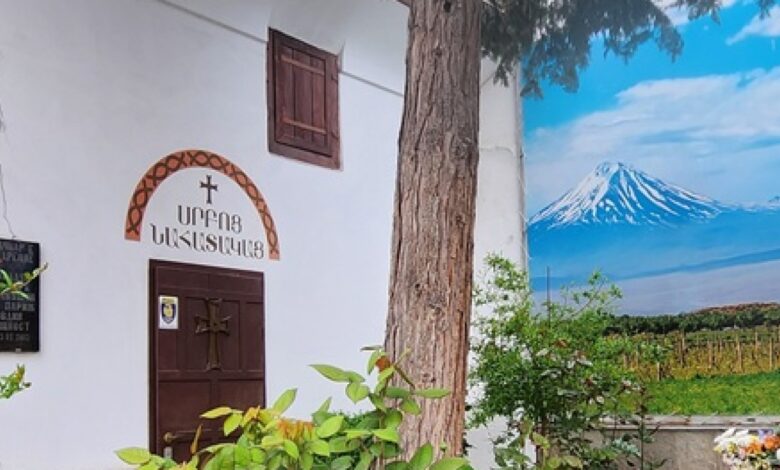
After a few more stops, we ended the tour in the common courtyard of the “Surp Kevork” Church, the community center, the Armenian school, and the House of Culture. This is the heart of the community in the city under the hills, where our guides drew our attention to a hachkar (stone cross) monument dedicated to the 90th anniversary of the Armenian Genocide, as well as the sarcophagus of a noble Armenian, whose stone block was relocated from the former Armenian cemetery near Monday Market.

The Armenian school is currently the only one of its kind in Bulgaria and is among the oldest in the country. Initially, it only taught boys, but later a girls’ section was added. After 1920, the two were merged.
The church was originally Eastern Orthodox and dedicated to St. George the Victorious. In 1767, it was handed over to the Armenian Diocese of Plovdiv. It is the only church with side sections in addition to the central nave—one for women and the other for men. A chapel was built next to the church. After several reconstructions, the church acquired its current appearance.

The tour lasted almost two hours, and we were all captivated by the stories that Adi and Teo skillfully told and illustrated for us, revealing many facts and details we often overlook in our everyday routines.
Stay tuned for future dates on our events and social media!