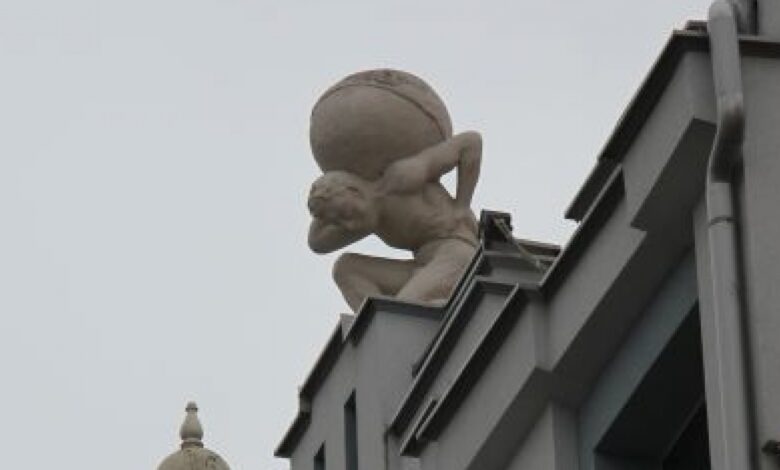
The building, well-known throughout Plovdiv for the sculpture of Atlas atop its façade, was designed in 1924 by architect Stoyko Stoykov. Its exterior features are characteristic of the Art Deco style that dominated much of Europe at the time, with vertically elongated proportions, narrow and tall windows, an elegant overall appearance, and stepped cornice finishes.

The sculpture is attributed to the Italian artist Emilia Favretto-Sabeeva. She arrived in Bulgaria as the wife of Atanas Sabeev – a doctor of commerce and finance and the founder of the first school of commerce and finance in Southern Bulgaria. One of Plovdiv’s most beautiful buildings – known among locals as “The House with the Nymphs” – was also built according to her design.
Emilia was born in Venice and was a relative of the renowned Italian painter Giacomo Favretto. Upon her arrival in Bulgaria, she applied for Bulgarian citizenship. She studied at the Royal Academy of Florence under Professor Razi, specializing in art criticism, and later became one of the first female architects in the country. She also authored the sculptural figures of the former “Maritsa” pharmacy, as well as the decorative plastic work of the “Metropol” Hotel (today the façade of the Plovdiv Theatre facing the main street).
The building at 41 Knyaz Alexander Street originally housed the “Napredak” Consumer Cooperative until 1941. After its nationalization in 1947, it became the administrative office of the RPK “NARKOOP” Plovdiv. In 1954, a large gourmet food store opened on its mezzanine level, by which time the street had been renamed 41 Vasil Kolarov Street.
The building is also interestingly linked to the nearby Grand Hotel Molle, opened in 1911, which offered the finest wines in the city. The hotel’s owners used the cellars of the Atlas building for wine storage – a practical solution paired with architectural elegance.
Today, the building houses a notable Plovdiv restaurant with a wine bar and remains a striking example of architectural beauty and dignified presence, bearing witness to the rich history of the City of the Seven Hills.