Our Sunday tour, part of the new initiative of the 365 Association for tours in Bulgarian under the hills, began in front of one of the most emblematic buildings of that era – the Dzhumaya Mosque.
The start was set with a short historical story and the dispute over the exact date of the capture of the city by the Ottoman army. According to most sources, this happened in 1370, with the residents peacefully surrendering the city after the soldiers cleverly cut off the water supply at the height of the summer season under the hills.
In the first century after falling under Ottoman rule, the city rather declined. Many travelers from the period described it as “a dirty and unmaintained city with dilapidated houses”. It was not until the middle of the 15th century that its gradual prosperity and more active construction began.

We have told you in detail about our first stop – the Dzhumaya Mosque – more than once in the guide. With its impressive size, it becomes not only one of the largest Ottoman monuments in Bulgaria, but also one of the most impressive buildings in the Balkans. This is also the only Sultan’s mosque in Bulgaria. A Sultan’s mahfil was specially built for the Sultan and his family, located on the left side of the building and with its own entrance.

An interesting fact is that at that time, in addition to mosques, inns and public baths were most actively built. Therefore, it is not surprising that we continued to our next stop – Kurshum Han. We also have a separate article about it, but we are proud to note the fact that inside it was the first Plovdiv cafe and probably one of the first in the Balkans. Kurshum Han was the most expensive place in Plovdiv, located in the most commercial part of the city. Today, the only material evidence of its existence is the massive doors that are kept in the Ethnographic Museum.

The entire area around today’s Central Halli was extremely lively and filled with numerous shops, in which trade was bustling. You can best understand what Kapana was like in the past from the following text, and we headed behind the building of the former Detmag store, where two more of the most famous inns under the hills were located – Katsigra Han and Gavaz Han.

The first was run by a famous Plovdiv family and, in addition to being a shopping center, it also served as a cultural center, where various events were often held. It was there that Ivan Vazov opened his Office of Literary and Popular Activities in 1881. In Gavaz Han, Hristo G. Danov later opened his printing house.

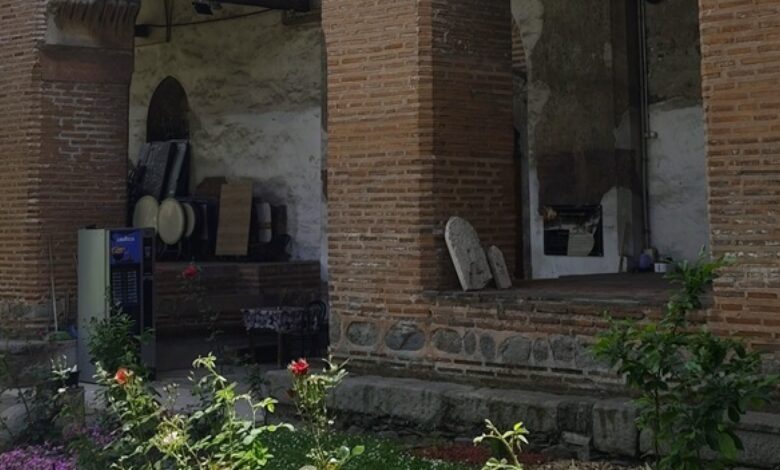
The participants in the tour also visited the second operating mosque under the hills – Imaret. In the past, it was used as a shelter for poor people, and sometimes for the mentally ill. Only they were allowed to paint on the walls, although over the years these traces have been erased.
We ended the tour with a story about the area around the mosque, also called the kyuli, and the final point was at the Taşköprü Mosque and the Orta Tomb. There, the guides took us back in time with photos of forgotten and no longer existing buildings and locations.