Plovdiv is a city that continues to reveal layers of its ancient past – often literally under our feet. Among the most interesting archaeological discoveries are the Roman thermae – public baths, which were not just a place for hygiene, but a social and cultural center of ancient Philippopolis.
Today, several locations related to such complexes are known in the city, some of them accessible and exhibited, while others have sunk into oblivion.
The complex at the Villa Flavia boutique hotel
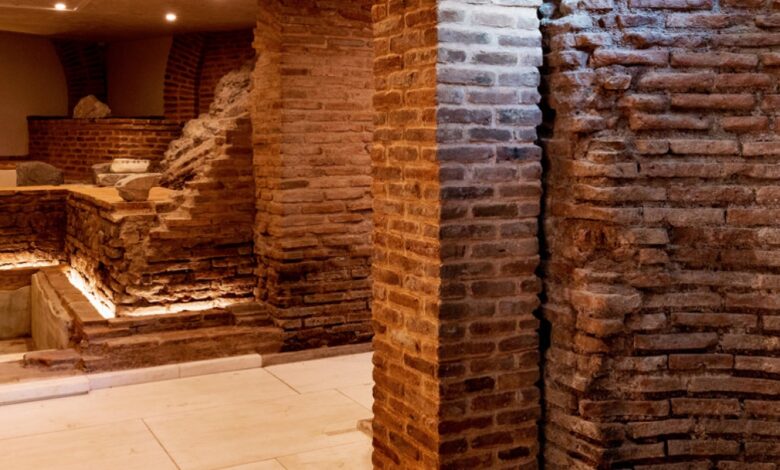
One of the most impressive discoveries in recent years was made during archaeological research at the Villa Flavia boutique hotel on Otets Paisii Street. When the activities began, archaeologists came across an excellently preserved room, which turned out to be part of a large complex of Roman thermae. It is believed that the structure extends under the neighboring buildings in the western, southern and northern directions and was probably connected in some way to the Roman stadium.

The discovery is particularly valuable, as it is the first time such an object has been registered in this part of the city and complements the idea of the scale and organization of ancient Plovdiv.
Among the most impressive elements is the well-preserved heating system – the so-called hypocaust. This is an ancient underfloor heating technology, in which warm air circulates under the floor and in cavities in the walls. In Villa Flavia, you can see subfloor brick columns, as well as tunnels used by the service staff to maintain the temperature. Some of them are exposed through a glass floor, which allows a direct view of the interior of the system.
In the center of the room there is also a small pool to which the heat was directed, another proof of the high level of engineering thought in the Roman era.
The forgotten bathroom under the Professional School in Home Appliances
Less well-known, but extremely interesting is the bathroom located under the building of the Professional School in Home Appliances . Access to it is impossible today, as the entrance, which is next to the official one of the school, was walled up in the 1990s.

This bathhouse is located in the eastern part of the ancient city, outside the fortress walls, near the Bishop’s Basilica. However, according to archaeologists, the exact period of its construction remains unclear.
The only more serious research was carried out between 1946 and 1950 by archaeologist Dimitar Tsonchev. According to his data, the bathhouse was probably built in the 4th century.
Its fate is dramatic – in the 5th century it was burned down, probably during the Hun invasions of the Balkans. It was subsequently restored, but with changes. The hypocaust was walled up, and parts of the building were rebuilt. It is assumed that a second floor was added at that time, for which massive columns and vaults were built.
The complex was impressive – with marble cladding and richly decorated mosaics, some of which have been preserved to this day. The end of its existence occurred around the 6th–7th century, when life in the city was mainly concentrated on the Three Hills.
The baths under the former Balkan Cinema
Another important point on the map of the Roman baths in Plovdiv is located under the building of the former Balkan Cinema, which today houses a casino and various offices
The remains were discovered in the 1930s and are considered to be some of the oldest known structures in the area of Stefan Stambolov Square. Archaeologists have established that these are two successive buildings – an earlier one, dating from the 1st–2nd century, and a later one, built in the 4th century on its foundations.

The complex included both cold and warm rooms, and the decoration was extremely rich – mosaics decorated not only the floors, but also the walls. Its location in close proximity to the Roman Forum suggests that this was one of the key public spaces in the ancient city.
The Roman baths in Plovdiv are just part of the city’s rich heritage, but they clearly demonstrate how developed and modern Philippopolis was in antiquity. From well-exposed finds to forgotten underground spaces, each new archaeological intervention completes the puzzle of the past.