The Sunday in May turned out to be one of the most suitable days to walk through ancient Trimontium and discover the most important places and remains of buildings from that time. Our guide on the tour was Iliya from the 365 Association, and his assistant in organizing the group of nearly 50 people was Adi.
Plovdiv became part of the Roman Empire in 46 AD, when Emperor Claudius separated the province of Thrace. At that time, the city was chosen as a metropolis and an important administrative center of the region, which marked the beginning of a real boom, marked by the rapid construction of public buildings, infrastructure and representative spaces. This rise ended dramatically in 251 AD with the invasion of the Goths, when the city was burned, destroyed and a large part of its population was massacred. Only in the middle of the 4th century did the locals manage to gradually revive the settlement, and the end of Roman influence on these lands is considered to be the 9th century with the gradual expansion of the First Bulgarian Kingdom.

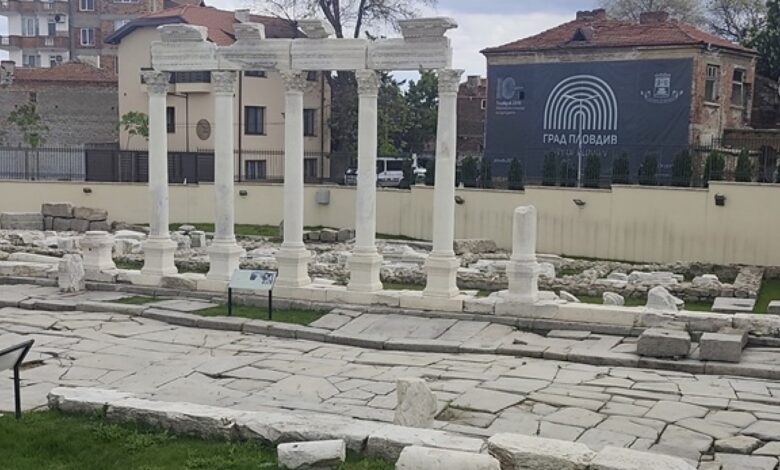
We started our tour from the western part of the Plovdiv Forum to the Central Post Office – the only one of its kind in Bulgaria, with a history that dates back to the time of the Thracians. This area was discovered in 2019, and in the past there were commercial premises here. In the northern part of the complex, some of the most important public buildings of the ancient city were located. We can easily orient ourselves where the Library was, probably built in the 2nd century and also used as a cultural center. A little later on our route we reach the Odeon, which originally functioned as an indoor building of the City Council, and in the 4th century it was converted into an open-air theater. Today we can see its reconstruction from the 1980s.

The walk also takes us to the Episcopal Basilica of Philippopolis and the story of the only synagogue of its kind in the Balkans, of which, unfortunately, no trace remains today. It was once located opposite the Church of St. Petka, on the site of what is now a large hotel from an international chain. We have also talked about these sites in more detail in our article dedicated to the religious tour under the hills.

The next stop is the Eastern Gate – the most massive entrance facility to the Ancient City. In place of the current stairs to it, you can see the remains of a triumphal arch, erected in honor of the visit of Emperor Hadrian in the 2nd century.
We also enter Old Plovdiv, where a number of sites continue to remind us of the Roman period – the remains of the Round Tower to Hisar Kapiya, parts of the fortress wall, and of course, we cannot miss Nebet Tepe. From there, an impressive view of the entire Plovdiv opens, accompanied by an interesting story about the function of the other hills and their importance in the public life of the ancient city.

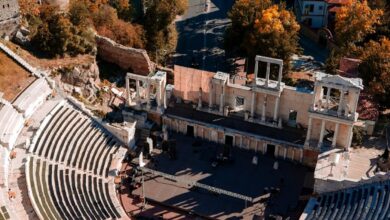
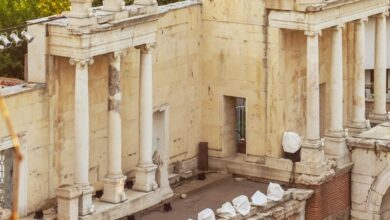
Our tour ended with two of the most emblematic monuments from this period – the Ancient Theater and the Roman Stadium, about which we once again learned curious facts and stories, proving why Plovdiv remains one of the cities richest in ancient heritage in Europe.
Sometimes we just need to look under our feet to realize how much history our city holds.